Recombinant Protein Expression: Systems, Methods and Applications
A comprehensive scientific guide to recombinant protein expression, covering molecular cloning, expression vectors, bacterial and eukaryotic host systems, protein solubility, post-translational modifications, cell-free synthesis, purification and analytical quality assessment.
Recombinant Proteins / Expression Platforms
Recombinant
Protein
Expression.
From genetic constructs to purified proteins: explore bacterial, yeast, insect-cell, mammalian and cell-free production systems, including their strengths, limitations and experimental applications.
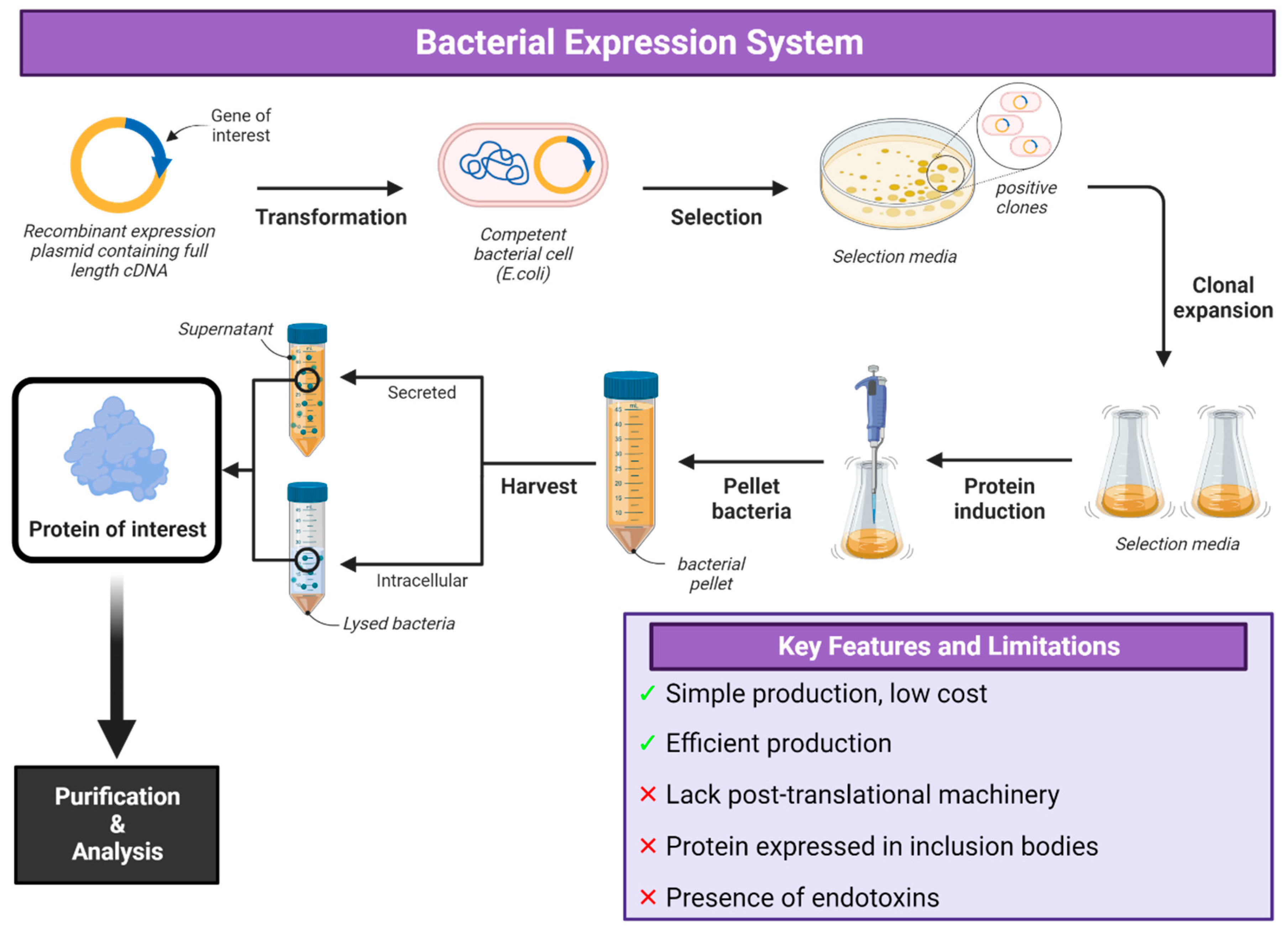
Recombinant protein expression is the production of a target protein using a biological host or cell-free synthesis system supplied with engineered genetic information encoding that protein.
What is recombinant
protein expression?
Recombinant protein expression is a core technique in molecular biotechnology. It enables researchers to produce proteins by introducing a selected gene into an appropriate expression system.
The gene of interest is generally incorporated into an expression construct containing regulatory elements that allow the chosen host to transcribe and translate the encoded sequence.
Once the construct is introduced into cells, the expression machinery can produce the recombinant polypeptide. Depending on the protein and host, additional folding, assembly or post-translational processing may be required.
The principal objective is not merely to produce more protein. It is to obtain material with the molecular properties needed for a defined research application.
Why are recombinant proteins important?
Recombinant expression supports fundamental studies of enzymes, molecular interactions, signaling pathways, structural biology and protein engineering.
It is also widely used in industrial biotechnology and biopharmaceutical development, although clinical applications require additional manufacturing, quality and regulatory controls.
From gene sequence
to target protein.
A recombinant protein expression workflow involves several connected stages. The exact sequence varies according to the expression platform and research objective.
1. Define the target
Researchers identify the coding sequence and determine which protein form is required. Considerations may include expression of the full-length protein, a domain, a variant or a fusion construct.
2. Design the expression construct
Expression constructs typically contain a coding sequence, promoter and other regulatory elements compatible with the host. Depending on the system, they may also contain affinity tags, secretion signals or selectable markers.
3. Introduce genetic information
DNA is delivered to cells using an appropriate transformation, transfection or other genetic delivery method. Cell-free systems use DNA or RNA templates directly in a biochemical reaction mixture.
4. Produce and recover the protein
The expression system synthesizes the target protein. Recovery depends on whether it accumulates inside cells, associates with membranes or is secreted into the culture medium.
5. Purify and characterize
Purification separates the target protein from unwanted sample components. Characterization assesses identity, apparent purity, stability and relevant biological function.
Expression yield, protein solubility and biological activity are different performance attributes. High expression alone does not guarantee a functional protein.
Protein expression
in E. coli.
Escherichia coli is one of the most extensively studied hosts for recombinant protein production. Its rapid growth, well-characterized genetics and accessible culture methods make it a common choice in molecular biology.
Bacterial expression is often suitable for proteins that do not require complex eukaryotic post-translational modifications.
Advantages of E. coli
- Established genetic and molecular biology tools.
- Relatively rapid growth and convenient culture conditions.
- Compatibility with diverse expression constructs and affinity tags.
- Useful platform for many enzymes, soluble domains and model proteins.
Important limitations
Bacteria generally cannot reproduce many complex eukaryotic processing pathways. Human-like glycosylation, certain folding requirements and protein assembly can therefore be challenging.
Recombinant proteins may also accumulate in insoluble inclusion bodies. These aggregates can complicate recovery of biologically active material.
When proteins are intended for sensitive applications, bacterial endotoxin contamination may require special consideration.
Yeast expression:
a versatile alternative.
Yeasts are unicellular eukaryotes that combine many practical advantages of microbial cultivation with cellular pathways for eukaryotic protein processing.
Commonly studied hosts include Saccharomyces cerevisiae and Komagataella phaffii, historically known as Pichia pastoris.
Why choose yeast?
Yeast systems may offer efficient cultivation, secretion of certain recombinant proteins and formation of disulfide bonds. They can also perform glycosylation and other eukaryotic modifications.
However, yeast glycosylation patterns can differ substantially from those of human cells. This difference may be important when glycan structure affects protein behavior.
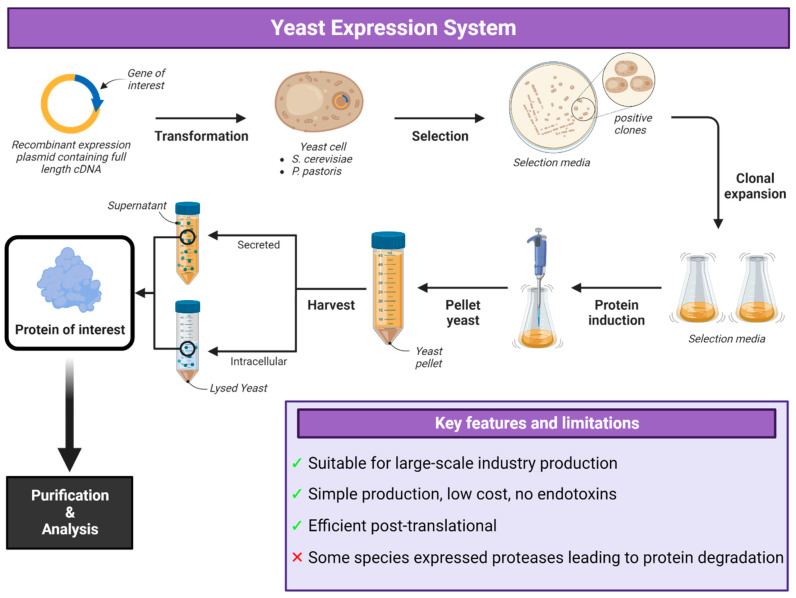
Yeast can be an effective platform for some secreted proteins, enzymes and biotechnology applications, but suitability must be assessed for the individual target.
Insect-cell and
mammalian expression.
Eukaryotic host cells can support expression of proteins requiring processing pathways that are absent or limited in bacteria.
Insect-cell expression
The baculovirus expression vector system (BEVS) is widely used to produce recombinant proteins in insect cell lines such as Sf9 and Sf21.
Insect cells can support folding and processing of various eukaryotic proteins, including certain multi-subunit complexes and membrane proteins.
Their glycosylation pathways differ from those of mammalian cells, so not every human protein will acquire native-like glycan structures.
Mammalian expression
Mammalian cell systems are especially valuable when protein function depends on eukaryotic folding, secretion or specific post-translational modifications.
Common research hosts include HEK293 and Chinese hamster ovary (CHO) cell lines. Expression may be transient or based on stable cell populations or clones.
Mammalian systems can provide processing capabilities relevant to many complex proteins, but production may involve greater cost and process complexity.
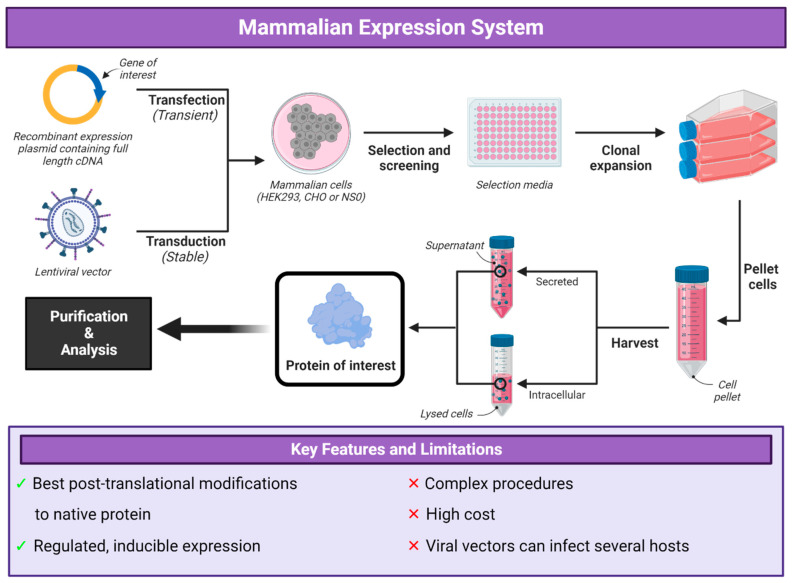
Producing a protein in a eukaryotic host does not automatically guarantee native human glycosylation or full biological activity. These attributes require appropriate evaluation.
How to choose
an expression system.
There is no universally superior recombinant protein expression system. Host selection depends on the biological characteristics of the target and the intended use of the resulting material.
| Host System | Typical Strength | Main Consideration |
|---|---|---|
| E. coli | Rapid and well-characterized microbial expression. | Limited complex eukaryotic modifications; possible inclusion body formation. |
| Yeast | Eukaryotic protein processing with practical microbial cultivation. | Glycosylation may differ from human-cell patterns. |
| Insect Cells | Useful for various complex eukaryotic proteins and assemblies. | Baculovirus workflow and host-specific glycan differences. |
| Mammalian Cells | Relevant folding, secretion and processing pathways for many human proteins. | Greater process complexity, time and resource needs. |
| Cell-Free | Direct control over an open synthesis reaction environment. | Yield, cost, reaction longevity and processing capabilities vary. |
Important selection criteria
- Protein size and structural complexity.
- Solubility and folding requirements.
- Need for disulfide bonds or post-translational modifications.
- Required protein quantity and acceptable production complexity.
- Intended biochemical, analytical or structural application.
- Purification requirements and necessary quality attributes.
A comparative scientific review of host systems is available in A concise guide to choosing suitable gene expression systems for recombinant protein production .
Expression yield
versus soluble protein.
A major challenge in recombinant protein production is the distinction between total protein expression and soluble, correctly folded material.
A target may accumulate at high levels but be difficult to recover in a functional conformation.
Inclusion bodies
In bacterial systems, some overexpressed proteins form dense, insoluble inclusion bodies. These structures may contain substantial amounts of the target protein.
Recovery can require separate solubilization and refolding strategies. The success of such approaches is strongly protein-dependent.
Experimental variables
Researchers investigate how host choice, construct design, expression rate, cultivation conditions and fusion partners affect protein yield and molecular quality.
Additional considerations include proteolysis, unwanted aggregation and instability during purification or storage.
Total expressed protein, soluble protein, purified protein and functional protein are not interchangeable measurements.
What is cell-free
protein synthesis?
Cell-free protein synthesis uses biochemical machinery derived from cells or reconstructed components to synthesize proteins outside living host cells.
These systems supply transcription and/or translation machinery along with the necessary templates, amino acids, energy sources and other reaction components.
Because synthesis occurs in an accessible reaction environment, cell-free methods can be useful for rapid research exploration and selected protein production applications.
However, their practical advantages depend on the formulation, target protein and intended scale of production.
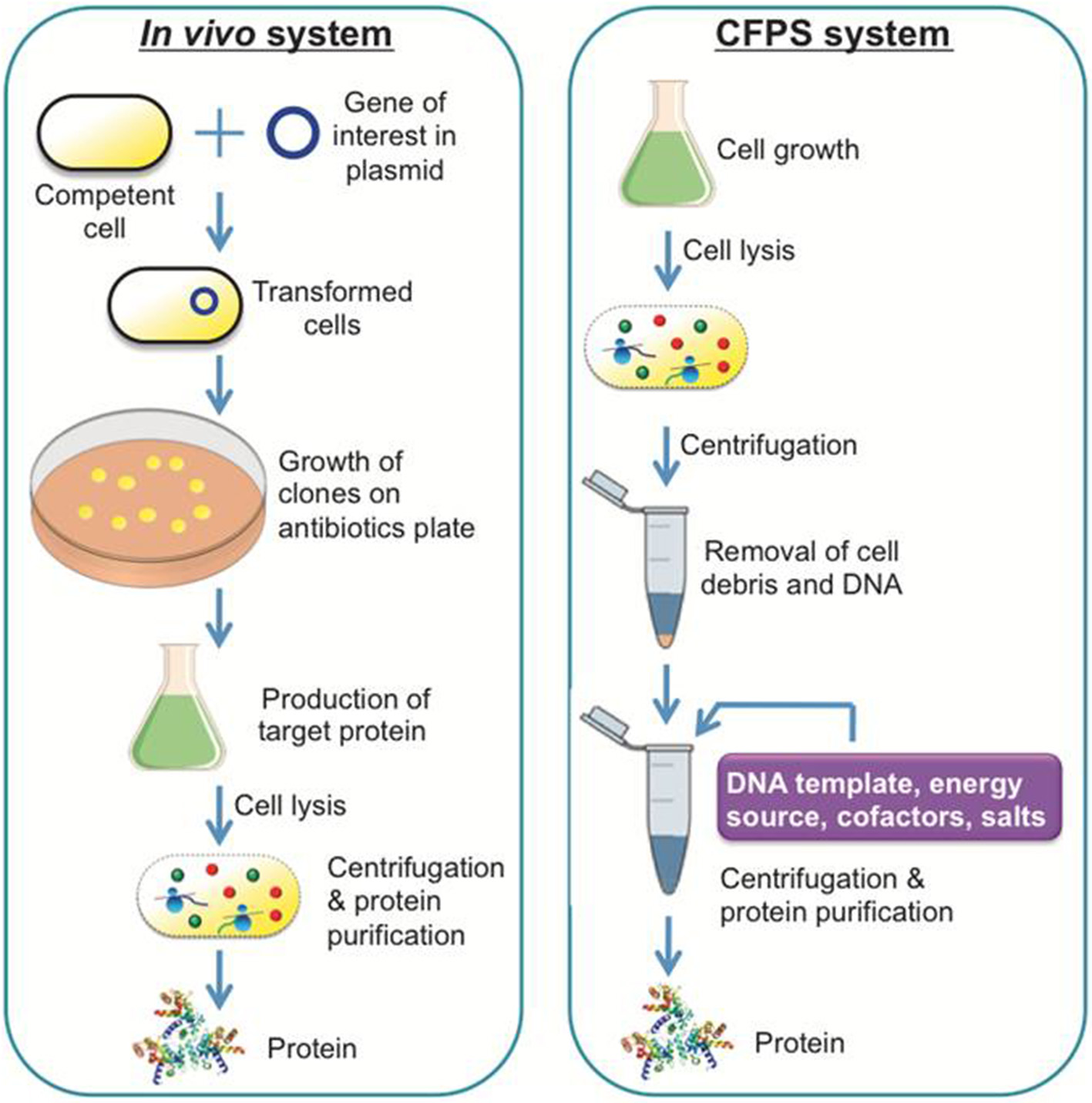
Cell-free synthesis complements, rather than universally replaces, conventional host-cell expression approaches.
Purification and
quality assessment.
Following recombinant expression, the recovered sample may contain host-cell proteins, nucleic acids, process-related components and different forms of the target molecule.
Purification strategies may use affinity, ion-exchange or size-exclusion chromatography, depending on molecular properties and the research objective.
How is the protein evaluated?
| Analytical Method | Primary Information |
|---|---|
| SDS-PAGE | Apparent molecular mass and visible sample composition under denaturing conditions. |
| Western Blot | Immunodetection of a target protein using appropriate antibodies. |
| Mass Spectrometry | Molecular mass, sequence-related identity information and selected modifications. |
| Size-Exclusion Chromatography | Separation by hydrodynamic size; useful for evaluating oligomeric or aggregated forms. |
| Functional Assay | Selected catalytic, binding or biological activity. |
The combination of these analyses helps researchers determine whether the material is appropriate for its intended application.
Educational Video: Electrophoresis (Part 1)
Academic lecture from NPTEL IIT Guwahati, presented by Dr. Vishal Trivedi. This companion lesson explains electrophoresis, an important downstream method used in protein characterization.
This educational resource is from an academic teaching channel, not a biotechnology supplier or product manufacturer.
Watch the original lecture on YouTube ↗
Recombinant protein
research applications.
Recombinant protein production supports diverse areas of biological research, ranging from enzyme mechanism studies to investigations of molecular recognition and protein architecture.
Structural biology
Purified recombinant proteins can support investigations using crystallography, cryo-electron microscopy or NMR spectroscopy. Sample quality is often critical to obtaining interpretable structural data.
Enzyme biochemistry
Recombinant enzymes can be used to investigate catalytic mechanisms, reaction kinetics, substrate specificity and inhibition.
Molecular interactions
Recombinant protein domains and complexes help researchers study binding interactions, recognition specificity and signaling processes.
Protein engineering
Expression systems allow researchers to produce protein variants and compare their molecular stability, activity or binding characteristics.
Research reagents
Recombinant production is also important for generating enzymes, antigens, standards and other materials used in laboratory research.
Key conclusion
The appropriate protein expression platform is determined by more than potential production volume. Protein folding, modifications, solubility, purification requirements and intended application must all be considered together.
Select the expression platform around the properties the final protein must possess, not simply around the highest possible expression level.
Scientific
references.
- A concise guide to choosing suitable gene expression systems for recombinant protein production. Open-access scientific review. Read on PubMed Central ↗
- Recent Developments in Bioprocessing of Recombinant Proteins: Expression Hosts and Process Development. Read on PubMed Central ↗
- Protein Expression Platforms and the Challenges of Viral Antigen Production. Vaccines. 2024;12(12):1344. Scientific article and figures ↗
- Exploring the Potential of Cell-Free Protein Synthesis for Extending the Abilities of Biological Systems. Frontiers in Bioengineering and Biotechnology. 2019. Scientific article and figures ↗
- Strategies to Optimize Protein Expression in E. coli. Scientific review ↗
- NPTEL IIT Guwahati. Electrophoresis (Part 1). Academic video lecture. Educational YouTube resource ↗
Recombinant expression,
explained simply.
What is recombinant protein expression?
Recombinant protein expression is the production of a target protein from engineered genetic information using a suitable host or cell-free system.
Why is E. coli used for protein expression?
E. coli offers rapid cultivation, well-established genetics and practical expression methods. However, it lacks many eukaryotic post-translational processing pathways.
Which system is best for human proteins?
There is no universal best system. Mammalian cells may be preferred when complex folding, secretion or specific human-like modifications are important, but many human protein domains can also be expressed successfully in microbial systems.
What are protein inclusion bodies?
Inclusion bodies are dense intracellular aggregates that can contain overexpressed recombinant proteins, particularly in bacterial expression systems. They often complicate recovery of soluble functional material.
Can yeast perform post-translational modifications?
Yes. Yeast performs several eukaryotic protein processing reactions, including glycosylation. However, yeast glycan structures often differ from those produced by human cells.
What is cell-free protein synthesis?
Cell-free protein synthesis produces proteins using translation machinery in an open biochemical reaction, rather than relying on living host cells during protein synthesis.
How can recombinant protein quality be checked?
Common analytical approaches include electrophoresis, immunodetection, chromatography, mass spectrometry and selected activity assays. Different techniques address different quality attributes.
From genetic
information to
molecular function.
Discover more protein research topics, experimental technologies and scientific materials through Fully Protein.
Explore Research Products ↗